Huairou district guesthouses
Wake up 20 minutes from the entrance and be on the wall at opening.
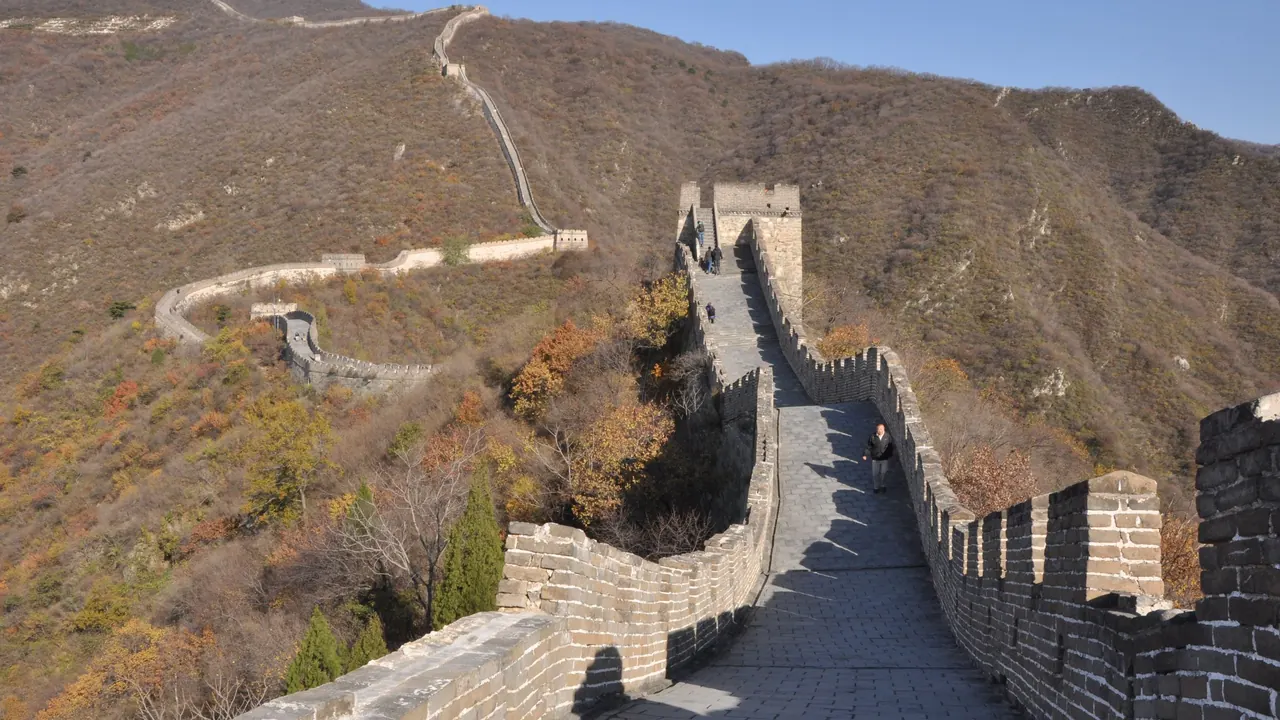
Restored enough to walk comfortably, wild enough to feel like a mountain ridge rather than a theme park.
Reservation: required before you go
Real-name booking. Passport holders do not exchange the ticket: show the original passport used for booking at the gate. Cable-car ticket holders must use the North check-in gate; toboggan/slide ticket holders must use the slide gate. Unused tickets can be refunded or changed until 24:00 on the visit date; refunds arrive within 7 working days (400-632-9662). Only watchtowers 1–20 are open (night session: 10–15).
Chinese address card · 中文地址
慕田峪长城
北京市怀柔区慕田峪村慕田峪长城景区入口和摆渡车站台
Give this to the driver. Confirm 慕田峪, not 八达岭 — the names are easy to confuse in a car.
Address precision: street
Restored enough to walk comfortably, wild enough to feel like a mountain ridge rather than a theme park.
The cable car up and toboggan down turns a hard climb into a two-hour visit that still feels earned.
Autumn colour here is the strongest argument in Beijing for rearranging your itinerary around a day trip.
Written and fact-checked for this page; the data modules above stay the source of truth for hours, tickets and reservations.
Mutianyu is the Great Wall section for people who want a ridge walk rather than a queue, and it rewards the same thing every good day trip rewards: an early start and a plan for the return. The site itself is simple — a restored stretch of wall running along a mountain ridge, with watchtowers you can walk between. The complications are all administrative: season hours, a real-name ticket you book weeks ahead, a cable car sold separately, and a transfer that is easy to get wrong in either direction.
We checked the scenic area's English and Chinese pages, its transport page and its announcement board on 1 November 2026. The route advice is ours; the hours, booking rules and prices are theirs.
Mutianyu sits north-east of Beijing and is the section most often recommended to visitors who want fewer people than the busiest option and more walking than a short paved loop. The trade-off is the transfer: it takes a chunk of the day, and the day is built around a morning departure and an afternoon return.
If you have a single free day and want the least logistics, this is still workable — the tourist shuttles exist precisely for that — but you should treat the wall as the day's single activity, not an add-on to a city morning. If you have two free days, Mutianyu is the one to give a full day to.
The season decides your hours, and the hours decide your day.
Peak season runs 16 March to 15 November. On Monday to Friday the scenic area is open 07:30–18:00; at weekends it stays open to 18:30. Off-season, 16 November to 15 March, the gate is open 08:00–17:30.
Two cutoffs matter more than the closing time. Ticket sales stop one hour before closing, and ticket check-in stops 30 minutes before closing. In practice the last hour belongs to people already on the wall — if you arrive in the final hour you will not get in.
The other timing rule is not published as a rule at all: the first hour after opening is the calmest. Buses and tour groups arrive later in the morning, so the earlier your transfer, the more of the ridge you get with space around you.
Mutianyu runs real-name reservations. Tickets can be booked up to 30 days ahead, and each document — ID card, foreign permanent resident card or passport — can buy one ticket per day. Bookings are made through the scenic area's own reservation channels, and the purchase requires a real name, document number and phone number.
You do not exchange the booking for a paper ticket. The scenic area's wording is that after a successful purchase there is no ticket exchange: you enter by presenting the original document you booked with. For a foreign visitor that means the passport, not a photograph of it.
Prices need reading carefully. The ticket page lists several products at different price points — CNY 40, 45, 60 and 200 in the current listing — and the cable car is a separate purchase from entry. The label matters more than the number: an entry ticket and a combination product that includes the cable car are not interchangeable, and the difference in what you get is bigger than the difference in price. Check the product description before paying, and check whether the cable car you want is one-way or return, because that is where the cost climbs.
There are three honest ways to reach the wall: the public bus, the paid tourist shuttle network, and a car.
The public bus. Take bus 916 from Dongzhimen to Huairou Beidajie station, then transfer to bus H7, H23, H24, H35 or H36 — all of which reach the scenic area. It is the cheapest option and the one that requires the most confidence: the transfer is a local bus with Chinese-language displays, and the wait can eat the early start you were counting on.
The tourist shuttles. The scenic area's official transport page lists a hub shuttle from the Qianmen transportation hub, 07:00–11:00, from Dongzhimen subway Exit H at about 09:10, and from Shaoyaoju subway Exit E at about 09:30. They return from car park P4 between 13:00 and 16:00. The published price is CNY 80 per person round trip, not covered by the Beijing transport card, bought on the bus from 30 minutes before departure until it fills.
There are also six branded tourist lines with their own pick-up points and timetables: Mu Bus from Dongzhimen Exit B1 at 08:00 and 10:00, Zan Bus near Wangfujing at 08:00, 09:00 and 10:00, Beidou from Chaoyangmen and Shaoyaoju, Jinma from Dongsi and Shaoyaoju, Busda from Hepingxiqiao, and Mujiaren from Qianmen, Shaoyaoju and Liangmaqiao. Each sells through different platforms. The detail that matters is the return time — ask before you pay.
By car. The scenic area's own direction is Exit 13 of the Jingcheng Expressway, then follow the signs. A private car is the most comfortable option for a family, but agree the waiting time and the total price in advance, and confirm the driver means Mutianyu (慕田峪) and not another section.
Start at the gate and head for the ridge. The restored stretch runs between watchtowers, and the usual plan is to walk one direction, stop where the view opens up, and come back by the cable car or the toboggan if you want to save your legs. The cable car is worth considering for the ascent even if you walk down: it removes the steepest hour and leaves you the ridge.
Two things to check before the morning. The first is the announcement board: the scenic area posts temporary closures for weather and conservation work, including a notice that the section between watchtowers 16 and 17 is under restoration. The second is the weather at the ridge, which is windier and colder than the city; a wall that is pleasant at noon can be unpleasant when the wind picks up.
Booking for the wrong day. The ticket is date-bound and tied to your document, so a mistake in the date is a mistake you fix before you travel, not at the gate.
Buying entry and then discovering the cable car is sold separately. Decide which product you want before you pay, and check whether it includes a return or just an ascent.
Treating the shuttle as a bus you can catch whenever you like. The hub shuttles leave in a morning window and return in a fixed afternoon window; the wall is not a place to overstay.
Assuming the wall is open because the website does not say otherwise. Temporary closures happen, and they are posted on the announcement page rather than in the opening-hours table.
Distance to the gate matters more than the star rating. Compare both options before booking.
Wake up 20 minutes from the entrance and be on the wall at opening.
Where the shuttle leaves from; avoids a 06:00 taxi across the city.
Mutianyu if you want fewer people and a longer walk; Badaling if you want the shortest transfer and the most restored wall. Mutianyu is usually worth the extra hour in the car.
Book entry and the cable car online a day ahead. Weekend slots and holiday dates sell out; the wall itself has no capacity issue once you are through the gate.
Yes: a direct tourist shuttle from the city, or a private driver. Neither requires a guided tour, but both require booking a seat ahead of the departure morning.